
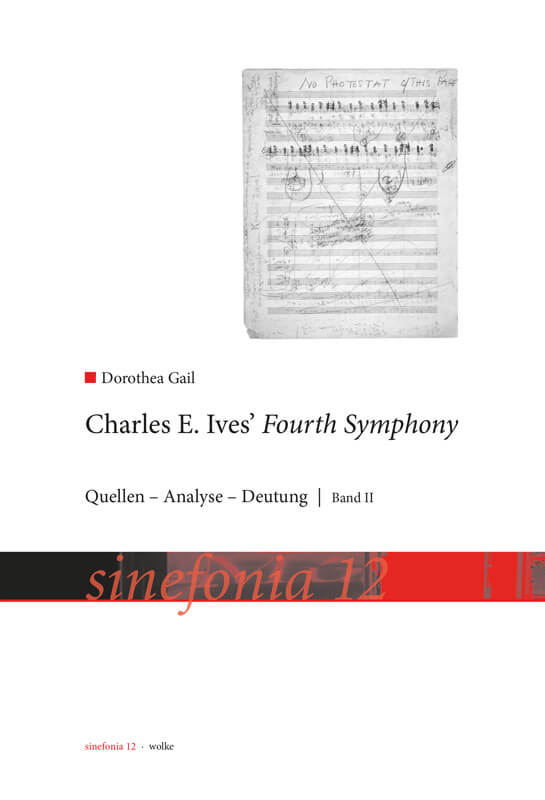
sinefonia Vol. 12
Dorothea Gail

Charles E. Ives Fourth Symphony

Quellen – Analyse – Deutung

Charles E. Ives' Fourth Symphony is the last completed major work of his musical oeuvre. Here, for the first time, a comprehensive study of the sources is documented, providing new insights into Ives' compositional style, the musical text, the problems of dating and the history of its composition. It is shown that Ives originally worked out the symphony in three movements until 1916/17 and only added the present second movement after 1921. The sources for the final chorale of the 4th movement suggest that Ives wanted the chorale to be sung on text and not, as previously practiced, only intoned on vocalise.

Extensive studies of the form and structure of the movements not only reveal all quotations, but also come to the conclusion that nothing in the motivic material, especially in the 2nd movement, is arbitrarily placed. All the individual parts can be derived from the railroad theme, the human-faith melody or a song quotation. The parameters of freedom and regularity are individually redefined by Ives.

Various possible interpretations define the field of multiple human worlds of ideas. Expressive ("listening") analysis and reflection on Ives' individual compositional techniques lead to ways of thinking that attempt to overcome form-content dichotomies. Separated from the individual multiple possibilities of interpretation, the composition is assigned a superordinate "meaning" with the help of the term "toucher" (Jean-Luc Nancy).

contents

free shipping within Germany

Print: 1004 pp. (vol. 1: 548 pp., vol. 2: 360 pp., vol. 3: 96 pp.), pb., music examples, reprint of the 1929 score, large format, € 119,00, 978-3-936000-72-6
Language: German

Weight: 2.2 kg

119,00 

incl. VAT, plus shipping costs if applicable

Enter your search here

When searching for ISBNs, please omit the hyphens!