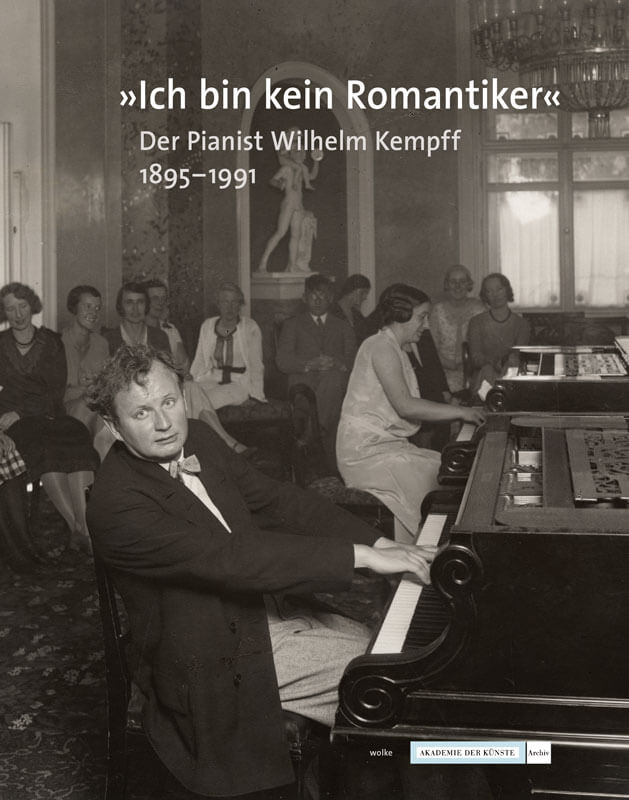
Documents on his life and work.
Exhibition catalog for the exhibition of the same name in Potsdam
From November 23, 2008, to February 1, 2009
"I remember one of Liszt's last students, a famous marquis in Italy. I had to play Brahms' Paganini Variations in Florence, around 1921/1922. Since I didn't have time to eat anything—it was an afternoon concert—I took a cheese sandwich with me and said to the marquis: 'Let's walk.' 'Liszt wouldn't have done that,' he said, 'he would have taken a four-horse carriage and had his servant bring him something to eat on silver trays.' 'Times have changed,' I replied, calmly continuing to eat and not letting myself be disturbed." Wilhelm Kempff
The image of Kempff as a high priest of the piano, as record companies liked to promote with appropriately staged portraits, needs to be corrected. Born in Jüterbog in 1895 and died in Positano in 1991, pianist Wilhelm Kempff gave his first solo concert in Potsdam in 1906, played for Ferruccio Busoni as a young man, soon appeared in all the major music centers, and ended his international career in Paris in 1981. His career was exceptionally long and successful. His career as a recording artist since the early 1920s, which quickly established his international fame, was also unprecedented. But Kempff never wanted to claim for himself the aura of aloofness that Liszt naturally surrounded himself with, even though he was virtually idolized by audiences in many countries.
Instead, Kempff lived a life devoted to the world and to people, never allowing his artistic independence to be compromised by external positions of power or institutional ties. He was appointed director of the Stuttgart Music Academy in 1924, but resigned from this position of his own accord after five years. In 1932, he was appointed to the Academy of Arts under Max Liebermann, but he did not want to join the academy that was newly founded after the war, just as he never served on a competition jury. This may have been a consequence of the painful realization that he had allowed himself to be too easily drawn into Nazi cultural propaganda. His claim that he could maintain such independence even in the "Third Reich" proved to be a serious political error, which Kempff later sought to compensate for in a very personal way—through his commitment to world peace as well as through international artistic understanding in his Beethoven courses.
Kempff remains in the memory of listeners worldwide for his post-war recordings of the classical-romantic repertoire. His recordings of the piano works of Beethoven, Brahms, Schumann, and Schubert set standards that remain valid today with their free and personal, yet very precise and lucid conception. His lesser-known recordings are also significant, including the Liszt recordings made in London around 1950, which Alfred Brendel praised not only for their unsurpassed technical mastery, but also counted among the greatest examples of poetic piano playing he knew. The exhibition uses numerous original sources to describe Kempff's life and his significance for the history of piano playing, as well as his achievements as a teacher and composer: Kempff wrote music throughout his life, but always remained, very consciously, a child of the 19th century.
contents
free shipping within Germany