
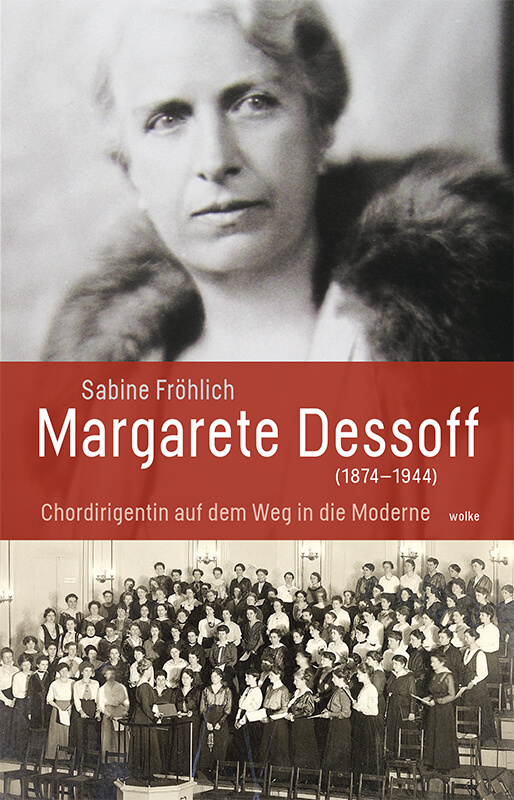
It all began with a voice break: Margarete Dessoff, daughter of the first conductor at the Frankfurt Opera, actually wanted to become a concert singer, but had to give up this dream when she lost her voice during singing lessons. Only after years of working with the singer Jenny Hahn did she regain control of her voice. Based on this experience, she opened her own singing school and formed the "Dessoff Women's Choir" from among her students, which became famous throughout Germany before World War I. Her concerts developed into a forum for rarely heard secular and sacred choral literature, for rediscovered vocal pieces of early music, and new works by young composers. With her programs and alternative concert formats, Margarete Dessoff set her own unique accents in the professional music world. She attempted to bridge the growing gap between amateurs and professionals, to establish the women's choir as an equal category in concert life, and to involve a choir culture rigidified by rituals in contemporary musical developments. With her successful performances as a conductor over three decades, she also challenged a seemingly natural gender order.
At the height of inflation in 1923, she moved to New York City, took over the choir class at what is now the Juilliard School of Music, and founded two independent choirs for mixed and female voices, which merged in 1931 to form the Dessoff Choirs, which still exist today. Her concerts, designed with a great deal of courage to take risks, were also perceived as highlights in New York's musical life, accompanied by influential critics and welcomed by a growing audience. When she retired from professional life in 1936, the New York Times praised her work as groundbreaking for choral culture and a cappella singing in the United States. Threatened with persecution in Nazi Germany as a "half-Jew," she first went to Vienna and, after the German invasion of Austria, moved on to Switzerland, where she spent her last years near Locarno.
"This excellently researched and brilliantly written biography focuses for the first time on the life's work of a pioneering woman who achieved extraordinary things in many respects. […] Sabine Fröhlich's biography traces in detail and with great excitement the path of a musician who gave professionals and dedicated amateurs the opportunity to perform important sacred and secular choral music from all eras, even beyond the standard repertoire. The facsimile concert programs offer a wealth of inspiration for choir directors and concert dramaturgs, while also presenting milestones in the history of the reception of early music in the early 20th century." Kolja Lessing (üben & musizieren 4/2020)
"Rarely does a book fascinate the reader from the first letter to the last as much as this one. [...] At the end of this encounter with a fascinating life in the service of choral music, what remains is sadness and shame—about the complete destruction of these truly culture-promoting networks in Germany, about the comparatively narrow-minded cultural restoration in this country after 1945, especially in the field of choral music domesticated by church music, about the decades-long marginalization of women's abilities and the wonderful cultural achievement of women's choirs, and much more. Konrad Klek (Musik & Kirche 4/2020)
contents
free shipping within Germany