
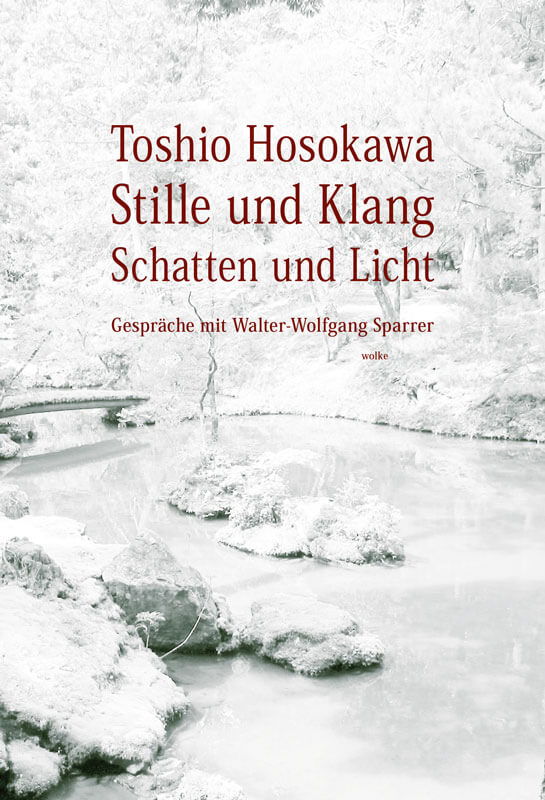
Toshio Hosokawa

Stille und Klang, Schatten und Licht

Gespräche mit Walter-Wolfgang Sparrer

The compositional work of Toshio Hosokawa, probably the most internationally renowned living Japanese composer, is a (re)construction of Japanese music that cannot be understood solely in terms of its location in traditional Japanese culture. Traditional Japanese music, the aesthetics of sound and silence as developed by Tōru Takemitsu and others in his writings, Isang Yun's conception of the elongated and differentiated single tone as a "brushstroke", but also serial techniques that Hosokawa became familiar with through Brian Ferneyhough and Klaus Huber, as well as impulses emanating from Helmut Lachenmann, are key influencing factors. When Hosokawa refers to traditional Japanese culture, which is only cultivated by a few in Japan, and at the same time changes it characteristically - in accordance with his distinctive individual personal style - and seeks links to Europe and the new European music, something new and unique emerges.
In 15 conversations with Toshio Hosokawa, Walter-Wolfgang Sparrer attempts to differentiate the image of the composer. Based on the biography of the musician, who was born in Hiroshima in 1955, these conversations aim to shed light on Hosokawa's aesthetics and compositional craft, as well as discussing individual works and groups of works, including three operas and numerous orchestral pieces and instrumental concertos. The New Seeds of Contemplation for Buddhist ritual chant and an ensemble of traditional instruments (1995) is presented in detail.
Hosokawa's musical thinking, his turn to traditional Japanese texts, his idea of melodic cantabile, which is linked to ideals of calligraphy and ink painting, his particular view of nature, influences of Buddhism and the Kyōto school with its attempt to combine Zen and Western philosophy, Buddhism and ontology (existential philosophy) are repeatedly mentioned. The historical references are explained by annotations and detailed illustrations. The reader is given an almost incidental insight into the background of Japanese culture.
This volume, generously equipped with musical examples, a chronicle, a list of works and a discography, also documents Hosokawa's role as a mediator of European new music in Japan - as a teacher in Tokyo and Hiroshima, as festival director in Akiyoshidai and Takefu.

Biography, catalog raisonné, discography

With a foreword by Helmut Lachenmann

contents

free shipping within Germany

Print: 224 pp., hardcover, ill., music examples, € 29,00, 978-3-936000-47-4
Language: German

Weight: 0.6 kg

29,00 

incl. VAT, plus shipping costs if applicable

Out of stock

Enter your search here

When searching for ISBNs, please omit the hyphens!