
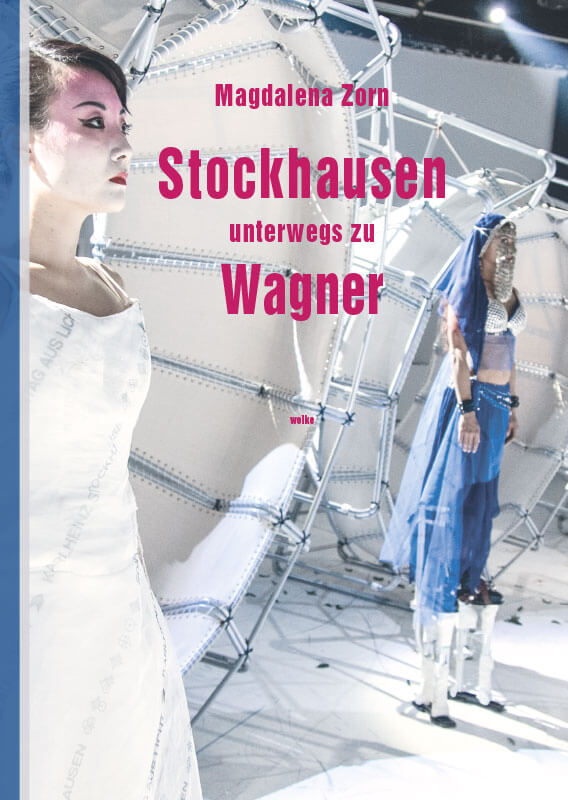
Magdalena Zorn

Stockhausen unterwegs zu Wagner

Eine Studie zu den musikalisch-theologischen Ideen in Karlheinz Stockhausens Opernzyklus LICHT

The German composer Karlheinz Stockhausen, one of the defining figures of 20th-century music history, created his works after 1950 explicitly from a post-Romantic perspective. Stockhausen’s departure from Romantic expressive aesthetics and the concept of art as religion, beginning with his first serial and electronic works, was fundamentally linked to the figure of Richard Wagner, who had been devastatingly co-opted ideologically by the National Socialists before the start of his compositional career. Despite this biographical circumstance, which explains Stockhausen’s lifelong reserve toward Wagner, his oeuvre is characterized by a specifically Wagnerian continuation of German-Austrian musical history. He transmitted and transformed Wagner’s artistic maxims above all through his seven-part music theater work LICHT (1977–2003), which far surpasses the temporal scope of The Ring of the Nibelung and the world-explaining gesture of Parsifal. This publication highlights essential music-historical and cultural-historical connections between LICHT and Wagner’s musical theater cosmos—connections that were obscured by the complex reception of Wagner in the 19th and 20th centuries—and thereby simultaneously challenges the notion of that “break” said to have divided music history in two around 1950.

contents

free shipping within Germany

Print: 356 pp., hardcover, ill. €44.00, 978-3-95593-065-3
Language: German

Weight: 0,92 kg

44,00 

incl. VAT, plus shipping costs if applicable

Enter your search here

When searching for ISBNs, please omit the hyphens!