
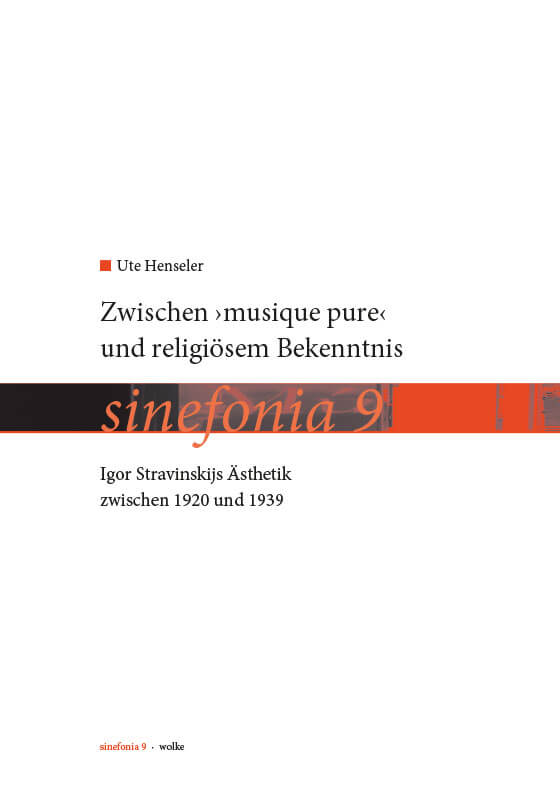
sinefonia vol. 9
Ute Henseler

Zwischen »musique pure« und religiösem Bekenntnis

Igor Stravinskijs Ästhetik zwischen 1920 und 1939

Igor Stravinsky's aesthetics, which have only received cursory treatment by scholars to date, are regarded as a cool plea for music for its own sake, free of any programmatic or metaphysical accessories. This book, however, demonstrates by means of a wide-ranging documentation and problematization of Stravinsky's aesthetic development in the two French decades that a religious subtext became increasingly apparent in his music-poetological maxims around 1930. In order to trace this spiritual component, the entire spectrum of musical and creative philosophical ideas that Stravinsky adapted for himself will be revealed. The emigrated Russian and cosmopolitan only took note of the aesthetic discourse in France through the filter of various intellectual role models, advisors and teachers. These offered him, the pragmatist, who mostly had his texts and writings written by others, adequate patterns of interpretation and a coherent rhetoric. The study is supplemented by a case study of Stravinsky's opera oratorio Oedipus Rex (1926/27), which demonstrates the (anything but congruent) relationship between aesthetic principles and artistic practice. This is the first comprehensive appraisal of Stravinsky's reflections on the nature of music. His aesthetic credo is characterized by an intertwining of purism and religious subtext, an oscillation between self-assertion and external attributions, eclecticism and partial inconsistency. However, it is precisely these ambivalences, this conflict between a composer and himself, that make up a significant part of Stravinsky's genius.

contents

free shipping within Germany

Print: 400 pp., pb., sheet music, € 44,00, 978-3-936000-69-6
Language: German

Weight: 0.75 kg

44,00 

incl. VAT, plus shipping costs if applicable

Enter your search here

When searching for ISBNs, please omit the hyphens!