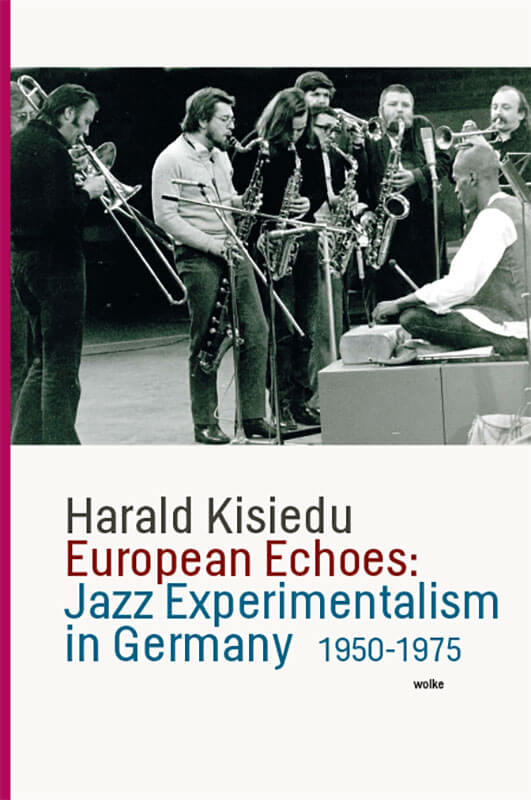
This book is a historical and interpretative study of the jazz experimentalism movement in West and East Germany between 1950 and 1975, expanding previous research narratives by demonstrating that engagement with African-American musical methods, concepts and practices played a central role in the emergence of German jazz experimentalism. In a seemingly paradoxical way, it was precisely this engagement with black musical knowledge that enabled the development of independent musical concepts and practices.
Instead of interpreting the German free jazz movement as a detachment from African-American "spiritual fathers", this book presents it as an essential contribution to the decolonization of a jazz historiography that to this day often assumes the dominance of the USA. Beyond US-centered and Eurocentric perspectives, this study makes an important contribution to global jazz research and to the understanding of transnational transfer of ideas.
"Few studies have understood how improvised music functions as a complex ecosystem - an interlocking system that overlaps and exchanges with other artistic, political and social spheres. Perhaps only George Lewis' A Power Stronger Than Itself and Kevin Whitehead's New Dutch Swing have so far succeeded in doing this. Harald Kisiedu's magnificent European Echoes: Jazz Experimentalism in Germany, 1950-75 joins these seminal works and brings indispensable substance to current research.
Drawing on meticulous research of primary sources that uncovers numerous previously unknown or overlooked details, Kisiedu moves with ease between biography, history, and analysis. He presents improvised music in Germany as part of a continuum with African American jazz—rather than, as is often claimed, as a break or even an “emancipation” from its American precursors and contemporaries. In this way, he succeeds in analyzing the complexities of race, particularly in the emerging new music of West and East Germany—as well as the specific characteristics of German improvisational music, its connections to Fluxus, and its position within the European art and new music scene.
At the same time, Kisiedu provides the most detailed biographical portraits of his protagonists to date - Peter Brötzmann, Alexander von Schlippenbach, Manfred Schoof and Ernst-Ludwig Petrowsky - in English. The book is supplemented by a large number of newly discovered, previously unpublished photographs."
- John Corbett, Chicago, author of "A Listener's Guide to Free Improvisation"
"Harald Kisiedu's groundbreaking interdisciplinary study powerfully demonstrates how first-generation experimental musicians in Germany and Switzerland crossed national, political, conceptual, and racial boundaries during the Cold War and beyond to develop new cosmopolitan forms and practices of free improvisation. Combining musicology with German studies, critical race theory, and political science, Kisiedu creates a rigorous yet intimate portrait of the musical, cultural, and personal relationships of these highly innovative musicians who fundamentally altered the musical landscape."
- George E. Lewis, author of "A Power Stronger Than Itself: The AACM and American Experimental Music"
Harald Kisiedu is a music historian and lecturer at the Institute of Music at Osnabrück University of Applied Sciences. He is also active as a saxophonist, improviser and recording artist.
contents