
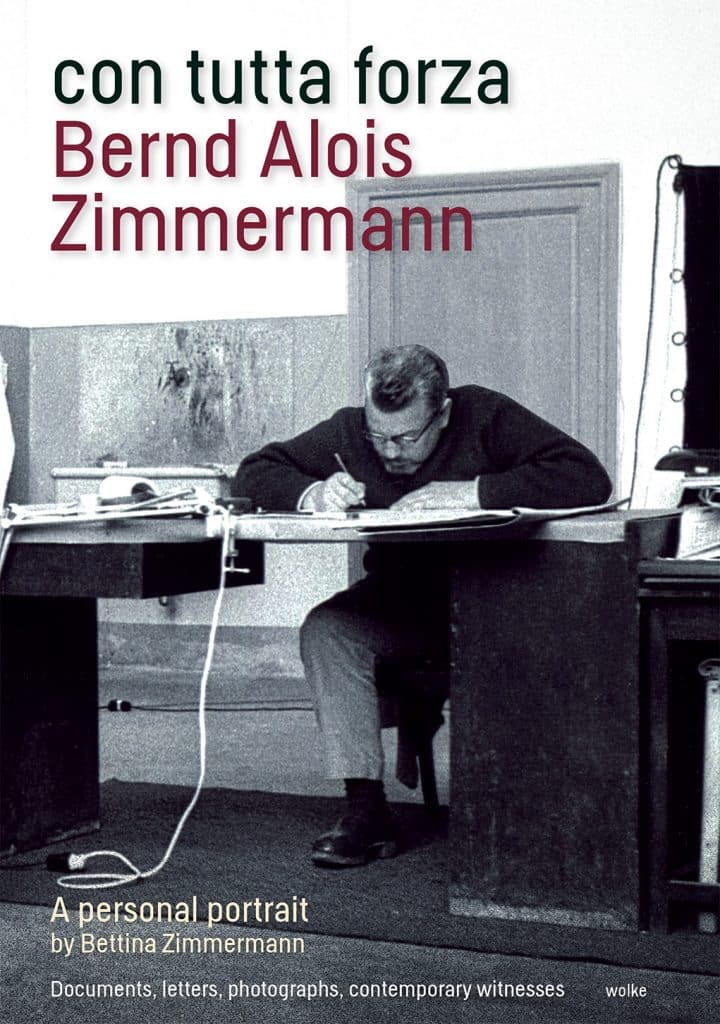
Bettina Zimmermann on her father, Bernd Alois Zimmermann
In the fall of 2010, I accepted an invitation to Strasbourg for the Festival musica, whose wide-ranging program included a “Hommage à Bernd Alois Zimmermann”: a two-day colloquium on his work, as well as numerous concerts featuring his chamber music and orchestral works. The composer and conductor Hans Zender was among the participants in the colloquium as a guest and speaker. We saw each other for the first time in many years, and it was his snow-white hair that struck me with a sense of dread at how quickly those years had flown by—and, along with that dread, the realization that those who had known my father, been friends with him, or worked with him would no longer be able to pass on their memories of him indefinitely. This realization—and the shock that came with it—sparked in me the impulse to ask my father’s friends, students, and interpreters to talk to me and share their memories of him. The initial idea was to compile a collection of personal memories of Zimmermann and authentic perspectives on his work, which could serve as a resource for a future biography—the author of which has yet to be found…
Thus, Hans Zender’s white mop of hair was the catalyst for what now lies before you as a book about my father. I wrote it as a daughter who “examines” her father’s life, work, and death; personally affected, yet striving to maintain a sense of distance in order to be able to observe and tell the story. My perhaps overly close familial bond as a daughter is broken up and put into perspective by the perspectives of others who were more distanced from my father: contemporaries who experienced and perceived him with varying degrees of personal closeness or distance. Thus, the source material for this book is the aforementioned collection of voices that I gathered from many hours of conversations.
When my father took his own life, I had just turned 18. His death and the preceding drama of his illness were traumatic events for me, the “aftermath” of which continues to have an impact to this day; they have helped shape the paths—and detours—of my life so far. Time and again, they cast a shadow over my memories of my father, like a black inkblot that at times threatened to plunge everything into its darkness. Anyone who studies Zimmermann’s work and life inevitably encounters this endpoint he set for himself: self-annihilation. His work is very often viewed against this “backdrop,” and his personality is examined through this lens; it helps shape the image of him that has become dominant in the music world in the decades since his death.
“Then I’ll draw you, and you’ll be in the picture!” was something like a magic spell my older brother Gereon used to shout as a child whenever he wanted to threaten or “punish” us. A magic formula—and, if the threat it contained were to be carried out, a kind of curse. This childish magic spell contains the idea that it would be a terrible punishment for a person to be depicted—and thus seen—once and for all, firmly bound within a (single) picture. The picture then becomes a prison into which the person is banished, with no possibility of appeal or escape, no opportunity for movement or variation: inescapably portrayed. An image shatters or is shattered, and with it the face trapped within it. It lies there in disarray, shattered, in a random order…: pick up the shards and reassemble the image—shatter it again and put it back together—repeat this process multiple times. From this, create portrait sketches that constantly recombine the existing material, in a ceaseless search for the face lying in between, beneath, and behind, for the “truth” of this face, which may be “many faces!” and contain “many truths.”
In this book about my father, I follow precisely this principle of exploratory synthesis. The collage technique lends itself well to this, as does the use of different materials: various types of text, photos, letters, conversations, images, and documents. To avoid the pitfalls of excessive familial closeness—and the blind spots that might come with it regarding my father’s personality—as well as out of a desire to provide scholarly “balance” to all work-related discussions, it became important to me as I progressed with the book to enlist the help of a competent mentor who could fulfill this role. I found such guidance in Rainer Peters and Heribert Henrich.
As it approaches the edges and limits of what can be told (or remembered), storytelling sometimes becomes halting or meandering, even fragmentary: it feels its way, asks questions, and searches. I accept these edges and acknowledge the limits. The narrative is not told linearly (“from beginning to end”) in order to offer a “complete portrait” or a “fully told” biography at the end. The most complete—and in any case, the most authentic—expression of Zimmermann’s personality, one that can be experienced most directly, is to be found in his music anyway: his biography is inscribed within it.
You are currently viewing a placeholder content from Vimeo. To access the actual content, click the button below. Please note that doing so will share data with third-party providers.
More InformationYou are currently viewing a placeholder content from YouTube. To access the actual content, click the button below. Please note that doing so will share data with third-party providers.
More InformationYou need to load content from reCAPTCHA to submit the form. Please note that doing so will share data with third-party providers.
More InformationYou are currently viewing a placeholder content from Facebook. To access the actual content, click the button below. Please note that doing so will share data with third-party providers.
More Information