
Why You Can't Take a Picture of a Sound Sculpture
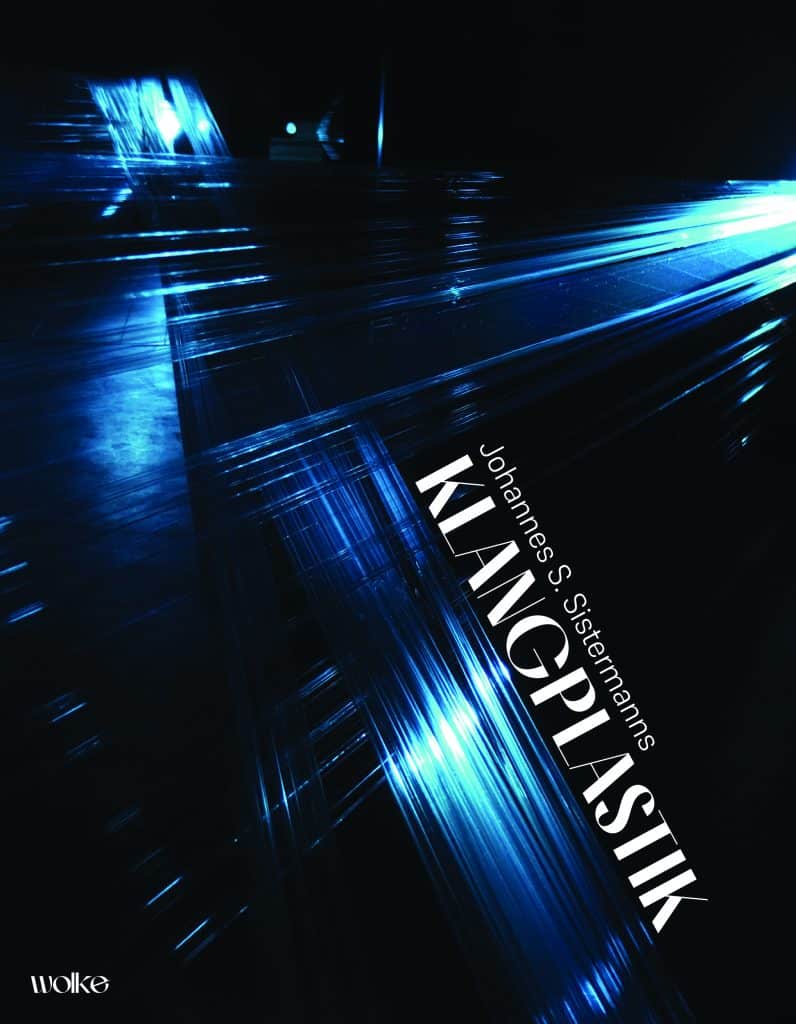
On the retrospective catalog of Johannes S. Sistermanns, KLANGPLASTIK. Arbeiten | Works 1985–2025
Anyone who spends months sifting through photographs of Johannes S. Sistermanns’ sound sculptures—for our catalog volume, we selected from 8,500 images—will have an experience that at first appears to be a technical nuisance but gradually reveals itself to be insight into the subject itself: It is almost impossible to photograph a sound sculpture from the outside. There are magnificent images of their surroundings, and magnificent images that lead outward from the interior of a work. But pointing the lens at them from the outside usually leads to nothing—in the case of Schnitt Stelle (2021), INTER FACE (Cologne 2023), and even luftzug (Darmstadt 2012). The exceptions are more revealing than the rule: Warming up living rooms (Adelaide 2000) can be viewed from the outside because here the boundary between the environment and the work is dissolved anyway—by the plants protruding from the windows, and at night by the light spilling out from within. And the open-air works function in both viewing directions. From this, one could derive a rule of thumb that says less about photography than about the works themselves: The photographability of a sound sculpture is inversely proportional to the decisiveness with which it draws a boundary between inside and outside.
The strange thing is that Sistermanns himself does not consider this boundary to be closed at all. A space, he says, is attentive; it listens to the outside world: Through the windows, we perceive what is happening outside, and outside, what is happening inside. His description of the space is that of a mutually permeable membrane—and it is precisely this membrane that is visually opaque.
The word “plastic” also carries a contradiction, though in a different way than it might seem at first glance. It is easily confused with “sculpture,” and sculpture is indeed the art form that thrives on the exterior: outline, silhouette, the act of circling around it. At least since Rodin, photography has been the primary medium for its dissemination, because a sculpture has a counterpart. “Plastik” refers to something else—a shaping from within—and even Beuys kept the terms in limbo for a long time before his “social sculpture” stepped out of the object and pointed the way into everyday life. From there, “sound sculpture” can be described as a sculpture that one hears before one sees it. It has no counterpart: one does not walk around it; one enters it. Sistermanns’ 2001 manifesto states it plainly—one enters the space, hears sounds, searches for their source, and finds nothing: “Sound cannot be located.” In front of the sculpture, the camera does exactly what the visitor does inside it: it searches for the source and does not find it. Only the visitor is compensated—she is inside. The camera has no “inside.”
A key technical decision Sistermanns has been making since 1997 is to be taken seriously. He no longer uses loudspeakers but instead transmits his electroacoustic compositions directly onto glass, stone, wood, and paper using coin-sized piezo membranes and transducers. The loudspeaker, he says, is “the coffin of sound”; rather than beginning something, it ends it. This is meant primarily in an acoustic sense—the space resonates with its own natural frequency rather than being filled with sound. But it is also a decision rooted in the politics of representation. For a significant part of what made sound art representable in the first place depended on the loudspeaker as an object: on Leitner’s tubes, on Kubisch’s cables, on Rolf Julius’s pigment-sprinkled membranes. These works are photogenic because they present a physical form. Sistermanns removes it. The transducer disappears into the material, and the material remains what it is.
This ties in with a second observation. There are magnificent close-ups—a piezo on a sheet of plastic—and magnificent long shots. There is little in between, because there is no formal relationship between the piezo and the plastic: the piezo is not part of the visible form, but rather the cause of the invisible one. What needs to be shown is not a part, but a transformation—the moment when a surface becomes a vibrating body. And that is precisely what the exposure time precludes. Perhaps that is why the most powerful images are those that reveal their own exposure time: the light trails of ma meta [Marl] (2020), the blue trails of Ma Un Ma (Donaueschingen 2016). They do not depict sound. They show that time has passed—and thus touch upon what Roland Barthes called the noema of photography: it does not authenticate what is, but rather that something has been. Photography is a medium of the past tense; sound sculpture exists in the present.
Perhaps a book about such a work must therefore define its status differently. It cannot be a fixed record. The images that carry the work are precisely those that relinquish any claim to evidential value: the blurred ones, those taken during the installation, and those directed from the inside out. Sistermanns himself provides the most useful concept when he speaks of notation: it is, in any case, always merely a template for an interpretation. These photographs function as a template—not as a representation. What remains is not an image of the sound sculpture, but the image of a search that came up empty. According to the manifesto, that is the experience at the heart of the matter.
The catalog volume KLANGPLASTIK. Arbeiten | Works 1985–2025 will be published by Wolke Verlag in early October. The volume includes the complete essay “Nach dem Klang” as well as other texts by, with, and about the artist.
You are currently viewing a placeholder content from Vimeo. To access the actual content, click the button below. Please note that doing so will share data with third-party providers.
More InformationYou are currently viewing a placeholder content from YouTube. To access the actual content, click the button below. Please note that doing so will share data with third-party providers.
More InformationYou need to load content from reCAPTCHA to submit the form. Please note that doing so will share data with third-party providers.
More InformationYou are currently viewing a placeholder content from Facebook. To access the actual content, click the button below. Please note that doing so will share data with third-party providers.
More Information